
In brief
Separate applications may work well individually, but money is lost between them through duplicate entry, inconsistent statuses and unclear responsibility.
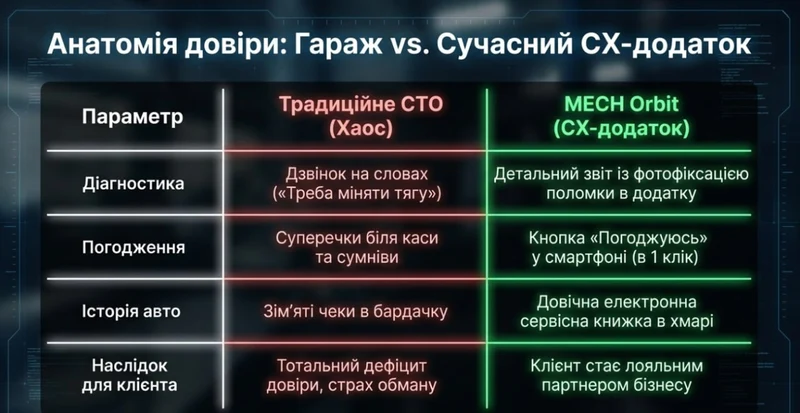
Most auto shops share the same problem: the business looks automated — but there's no real order.
CRM in one place. Inventory in another. Cameras separate. Phone system separate. Chats separate. Spreadsheets separate.
The owner ends up seeing not a system, but fragments. And it's exactly between those fragments that money starts to disappear.
In this article, we'll break down why separate auto shop tools don't solve the problem — and what it actually takes for an auto repair shop to run as a single, unified system.
What the Chaos Between Separate Programs Looks Like in Practice
Every one of these situations will be familiar to an auto shop owner:
- The car is already in the bay, but it's not in the CRM yet
- The mechanic found an additional problem, but the photo never reached the client
- The part arrived, but the technician found out late
- The work was completed, but the status was never updated
- The client is waiting for an answer, and the shop is losing time and trust
This is the core weakness of separate tools. Each one does something — but nobody sees the full picture.
What the Auto Shop Owner Actually Does With Separate Programs
Because the systems don't talk to each other, the owner is forced to manually stitch the business together piece by piece:
- Check one system, then another
- Ask in the chat, then call the service advisor
- Review the cameras, then cross-reference the spreadsheet
This isn't managing an auto shop. It's a constant fight against disorder.
Separate programs don't solve the problem. They just spread the chaos across different windows.
Where Exactly the Money Gets Lost Between Programs
As long as the shop operates with fragmented systems, it inevitably loses:
- Time — at the handoff points between people and systems
- Money — on missed and unlogged jobs
- Speed — on approvals and clarifications
- Discipline — in the repair zone where nobody sees the full picture
- Client trust — due to delays and lack of communication
3 Signs Your Auto Shop Is Running on Fragmented Systems
Check yourself:
- To find out a vehicle's status, you need to check multiple places — CRM, chat, cameras, ask the technician
- Information between departments is passed manually and regularly arrives late or gets lost entirely
- You can't give the client a quick answer without first checking with the team
How a Strong Auto Shop Works on a Unified System
A high-performing auto shop works differently. In it, vehicle check-in, mechanic work, defect photos, client approvals, parts, repair status, and analytics are all connected in a single loop.
What this delivers in practice:
- No need to manually pass information from place to place
- An event happens once — and everyone who needs to see it does
- Losses at the gaps between systems disappear
- Real control over the process becomes possible
This is what genuine auto shop automation looks like — not a set of separate tools, but a single unified digital system.
Conclusion
Separate programs don't build a strong auto shop. They only create the illusion of automation.
Money isn't lost inside one program — it's lost between them. As long as the auto shop is assembled from fragmented systems, the owner will always be putting out fires. When everything works as one system — order, speed, and profit follow.
Want to see how MECH Orbit connects all your auto shop processes into one unified system? Book a demo — we'll show you with a real example.
What to check in your workshop
- Count how often customer and vehicle data is entered
- Find processes that exist only in chats or spreadsheets
- Check whether a work order connects to inventory, payment and reports
Practical questions
Must every external service be removed?
No. Define one core system and retain external tools only where they are integrated and do not create duplicate entry.
Which process should be unified first?
The vehicle journey from booking to payment because it connects the customer, mechanic, parts and money.