
In brief
The CRMMECH API documentation is publicly available. It covers camera events delivered through Webhooks and data retrieval through the Pull API. Workshop owners can use it to discuss a custom integration with their existing CRM or 1C system.
From a vehicle arrival to an event in your system
If your workshop already uses an external CRM or business management system, you may want to connect a vehicle’s actual arrival to the team’s workflow. The public CRMMECH API documentation helps your developer establish which events and data can support that connection.
In this announcement dated 3 October 2026, we introduce the documentation and the new API section on the MECH Orbit website. The section brings together a short overview and links for your technical team.
Webhooks: receive arrival and update events
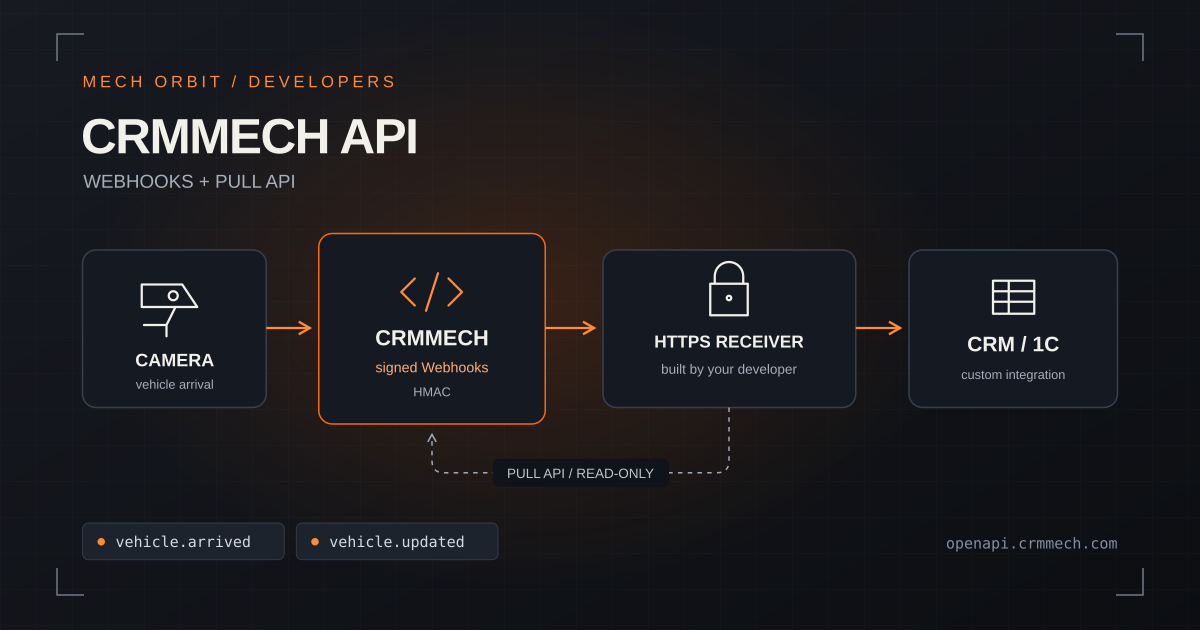
The documentation describes two event types: vehicle.arrived and vehicle.updated. They report a vehicle’s arrival and subsequent updates to its data. CRMMECH sends the event to the integration’s configured HTTPS receiver.
Webhook requests carry an HMAC signature. The receiver should verify it before processing a message, handle repeated deliveries correctly and maintain the link between the event and the relevant external record. The technical documentation sets out the request format and signature verification rules.
Pull API: retrieve data when you need it
The Pull API complements event delivery: your integration can request available data when its own workflow needs it. The published Pull API is read-only. Do not plan on using it to create or modify every type of CRMMECH record.
Your developer should check the required fields, request parameters, authentication and limits against the current API documentation. Before going live, also decide which system owns each field and how your team will verify the exchange.
What connecting a CRM or 1C requires
A developer needs to build the HTTPS receiver, implement signature verification and map the data to your specific CRM or 1C configuration. API availability does not in itself provide a ready-made universal connector.
Start with one workflow: an arrival event should find the corresponding record in your system or trigger an agreed action through that system’s own interface. Agree on vehicle matching, access permissions, data retention and error handling separately.
Run one controlled test first
- Give your developer the documentation and describe one action you need after a vehicle arrives.
- Prepare the HTTPS receiver and HMAC signature verification.
- Test both event types, repeated delivery and invalid-signature handling with test data.
- Verify the result in the external system and test the required Pull API request separately.
That test will show what works in your specific workflow and what still needs development before real data is used. Always check current technical requirements in the documentation.