
Every Bay in an Auto Repair Shop Can Be Occupied, but That Does Not Mean the Shop Is Profitable
To decide whether to add another customer to the schedule, a shop owner must separate lift occupancy, actual technician work and sold labor hours. These metrics are related, but they are not interchangeable.
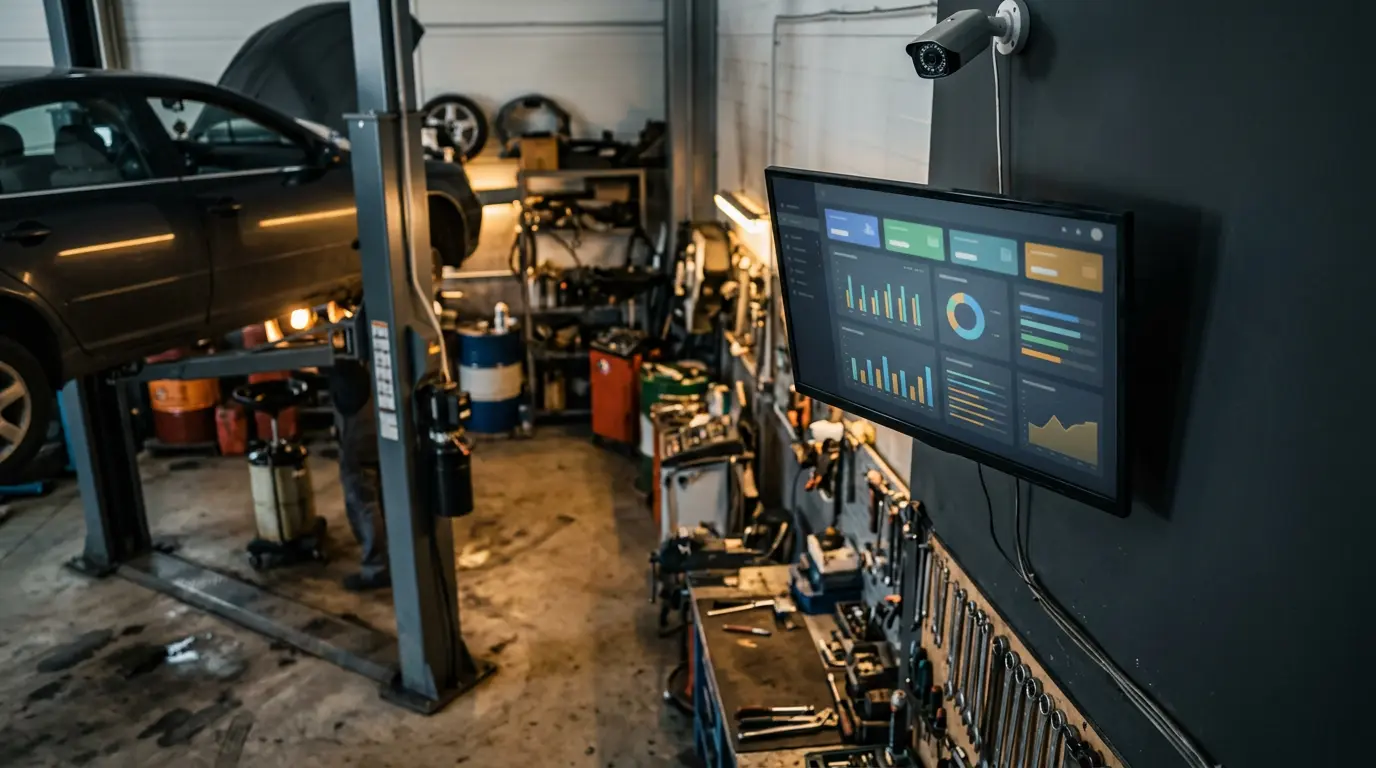
Every lift is occupied, the schedule is booked for several days, but revenue is growing more slowly than the queue. In this situation, it may seem that the shop needs more bays or technicians. But a new booking may simply add another vehicle that will wait for a part, approval or a technician.
It is a mistake to treat bay occupancy as a measure of sold capacity. A management decision requires three different time metrics: physical lift occupancy, actual productive work and labor hours approved and billed to the customer.
Three metrics that cannot be combined into one
Bay occupancy is the interval from when a vehicle is placed on the lift until the lift is freed during the work shift. It includes repairs, diagnostics, waiting for parts, approval and other stoppages.
Actual productive time is the period when a technician was performing diagnostic or repair operations. These are not necessarily paid hours. Diagnostics may be sold at a fixed price, omitted from the final invoice or take longer than the standard time allows.
Sold labor hours are the volume of approved and billed work on the repair order. They are determined by the shop’s labor-time standards, not by a stopwatch. A job worth two labor hours may actually take one and a half or three hours. A required process waiting period may sometimes be included in the standard even though the technician is not working on the vehicle at that moment.
Therefore, the formula “occupancy minus waiting equals sold hours” is incorrect. Subtraction can provide an approximate measure of active time, but sold labor hours must be taken only from the repair order.
A bay map for five comparable shifts
An initial review does not require comprehensive time tracking across the entire shop. Choose one bay and five normal, comparable shifts without holidays, emergency equipment shutdowns or other events that sharply change the workflow. Five days do not establish an industry benchmark, but they prevent a decision from being based on one unusual shift.
Create a map for each vehicle:
- vehicle placed in the bay;
- start of the first operation;
- work stoppage and its cause;
- receipt of the part or approval;
- work resumed;
- bay released;
- approved and billed labor hours on the repair order.
Use the scheduler, repair order or employees’ actual timestamps to determine when the vehicle entered and left the bay. Compare waiting intervals with the time of the parts request, the supplier’s response, the estimate being sent and the customer’s decision. Take sold labor hours from the approved and billed lines of the repair order, not from a technician’s comment.
If the exact start or stoppage time is unavailable, mark the interval as “undetermined” rather than assigning all of it to waiting for parts or approval. An employee’s approximate estimate should also be identified as an assumption. Otherwise, the table will show a convenient reason for the delay instead of the actual one.
Nighttime hours when the shop is closed should be excluded from shift-capacity calculations. Separately identify operations that require the vehicle to remain in the bay, including waiting periods required by the process. Classify them according to the specific job and the shop’s labor-time standards rather than automatically treating them as downtime.
Example calculation: identical occupancy, different conclusions
Suppose a vehicle occupied a bay for 8 hours during one shift. The timestamps show:
- 2 hours waiting for a part;
- 1 hour waiting for approval;
- 5 hours of diagnostics and repair operations.
At the same time, 4.2 labor hours were approved and billed on the repair order. The shift result should not be recorded as “5 hours sold,” but as three separate lines:
- bay occupancy — 8 hours;
- actual productive work — 5 hours;
- sold — 4.2 labor hours.
Suppose this is part of a sample review covering five shifts. During that period, the bay was occupied for 38 hours: 24 hours were spent on active operations, 7 hours waiting for parts, 4 hours waiting for approval, and another 3 hours remained unverified or were spent transferring the vehicle between stages. The repair orders included 20.5 billed labor hours.
These figures cannot determine the bay’s profit without labor rates, labor costs, discounts and the mix of work. But they indicate what to investigate. Adding bookings will not eliminate 11 hours of waiting and may increase the number of vehicles stalled in the process at the same time. The gap between 24 hours of actual work and 20.5 sold standard labor hours requires a separate reconciliation: which operations were included in the invoice, which were repeated, what was sold at a fixed price and how the labor standards were applied.
When to add a booking and when to change the workflow
A new booking is justified if the bay is regularly free over several comparable shifts, a technician is available and there are not enough vehicles ready for work. In that case, the actual constraint may be incoming demand or scheduling.
If the bay is occupied for almost the entire shift but a significant share of the intervals involves repeated waits for approval, first review the estimate workflow: when the technician submitted the findings, when the service advisor prepared the proposal, when it was sent to the customer and who followed up on the response.
If waiting for parts is the main issue, examine the connection between diagnostics, ordering, delivery and the time when the vehicle is placed on the lift. The solution may not be an additional booking, but placing the vehicle in the bay later, after part availability and delivery time have been confirmed.
If actual work takes up a significant part of the shift but few labor hours are sold, the schedule alone will not solve the problem. A sample reconciliation of repair-order lines is needed: the operation performed, the basis for its price, its approval and its inclusion in the final invoice.
A map of one bay cannot support conclusions about the entire shop if the bays are specialized, technicians work on several vehicles in parallel or one operation requires two employees. In those cases, collect metrics separately by bay type and do not simply add them together.
The main conclusion: auto repair shop bay utilization answers the question of where the vehicle is. That is not enough to decide whether to add another booking. The owner must separately see how long the bay is occupied, how long the technician is actually working and how many labor hours have been prepared for sale. Only then can the queue be treated as evidence of demand rather than the result of a breakdown within the workflow.
Sources and links
- Текущая публикация MECH Orbit
Исходная версия для редакционного обновления