
Vehicle in the service bay, owner unclear: why fast intake becomes a risk for auto repair shops
An auto repair shop does not need to become an investigation unit. But it must be able to reconstruct the history of every vehicle: who handed it over, which work they approved, what was installed and who received the keys. Here is how to build this process without unnecessary bureaucracy.
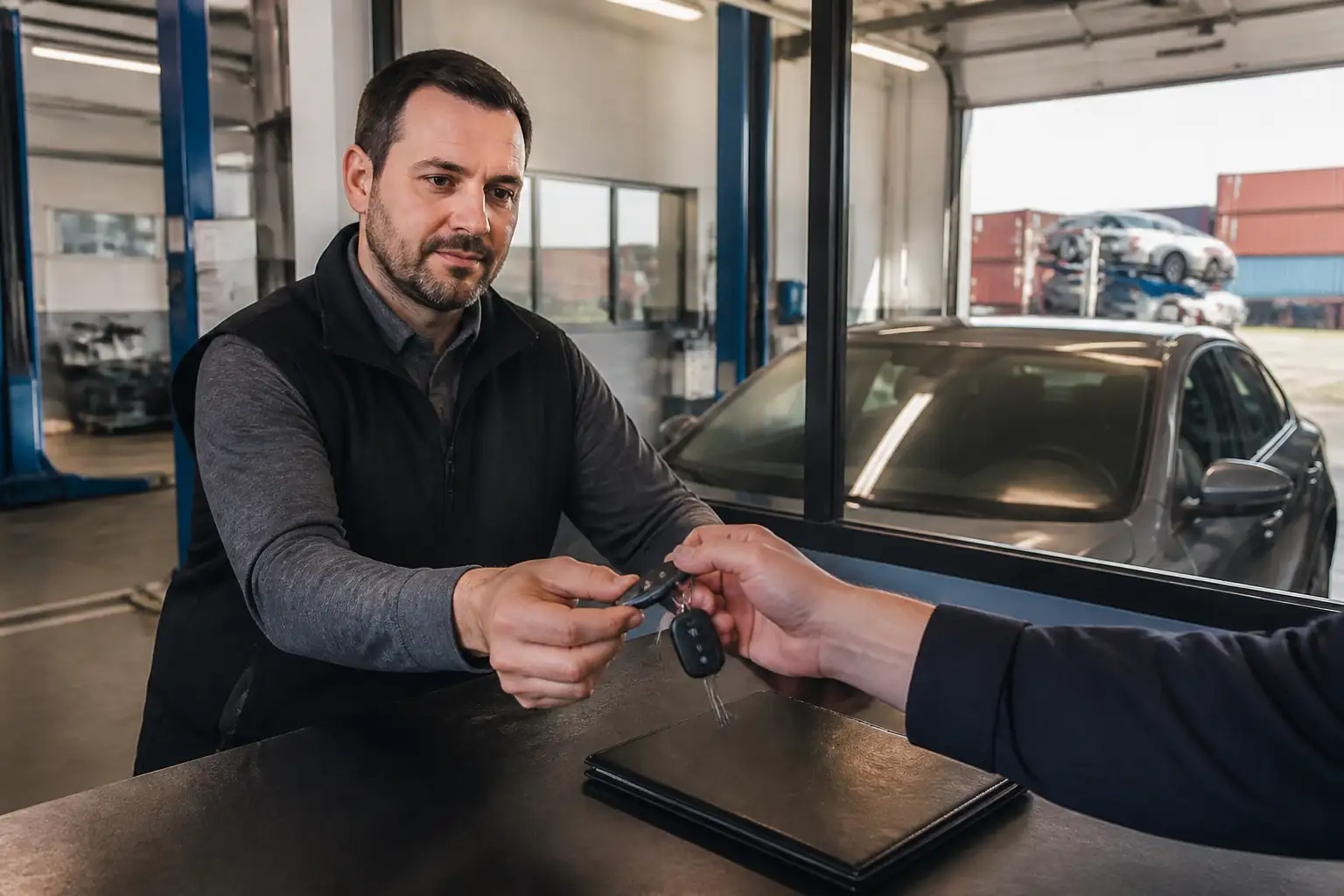
Morning at an auto repair shop. A vehicle is already waiting in the parking lot, and the keys are handed over not by the owner but by a “brother,” “driver” or “company employee.” The customer is in a hurry, the service advisor is answering a call at the same time, the technician is asking whether the vehicle can be brought in, and the documents are promised later via messenger.
From a technical standpoint, the situation is routine: the vehicle needs to be checked in, diagnosed and repaired.
From an operational standpoint, a gap has already appeared. The shop cannot yet confidently answer several simple questions: who handed over the vehicle, on what authority this person approves the work and who may receive the vehicle afterward.
This creates a paradox: the more convenient and faster an informal check-in is, the harder it becomes for the auto repair shop to prove exactly what happened to the vehicle. The speed with which the shop tries to help the customer can make the process unmanageable.
Information signal: fraudsters exploit gaps between systems
[Auto Service World](https://www.autoserviceworld.com/fraud-based-vehicle-exports-up-72-per-cent/), citing a Canadian Finance & Leasing Association report, stated that the number of vehicles obtained through fraudulent financing and sent for export in Canada increased by 72% year over year. The report’s authors link the problem partly to an information gap: a vehicle may leave the country before the participants in the system detect the fraud.
This is a Canadian story about financing and exports. It does not mean that a Russian auto repair shop should check liens, investigate the origin of every vehicle or take on the functions of the police and financial institutions.
But the signal for a shop owner is universal: a vehicle passes through several independent parties, and risks arise in the gaps between them. If each party has only a separate fragment of information, the full history cannot be reconstructed quickly.
The shop is responsible not for investigations, but for the integrity of its own process
An auto repair shop usually sees only a small part of a vehicle’s life cycle. It cannot know everything that happened to the vehicle before the visit and should not pretend that it can.
However, the shop has full control over its own part of the process:
- who booked the vehicle;
- who actually handed over the keys;
- which vehicle was accepted;
- what condition it arrived in;
- which work was requested and approved;
- which parts were used;
- who performed the operations;
- to whom and when the vehicle was returned.
When this information is spread across the CRM, a paper repair order, the service advisor’s phone, message threads and the technician’s memory, the information formally exists. Operationally, it does not: at a critical moment, no one can see the full picture.
That is why the main object of control is not a suspicious customer. The main object of control is a fragmented repair order history.
Six questions that should follow the vehicle
A single operational trail should be created for every visit. It can be built around six questions.
1. Which vehicle arrived
Recording the make and model is not enough. The repair order should contain an unambiguous vehicle identifier used under the rules of the specific shop: for example, the VIN and license plate number, if processing them is provided for by internal procedures and applicable requirements.
It is important not simply to complete the field but to check the information against the vehicle that actually arrived. An error in one character turns a carefully completed repair order into the history of a different vehicle.
2. Who handed over the vehicle
The customer in the CRM, the payer, the owner and the person who arrived at the shop may all be different people. This is not necessarily a problem in itself: company vehicles are brought in by drivers, family vehicles by relatives, and fleet vehicles by designated employees.
The problem begins when the shop does not record the distinction between these roles.
The service advisor does not need a reason to suspect the person, but a clear procedure: which details are recorded, how a representative is identified and what to do if the required information is unavailable. The scope of personal data checks and storage should be determined with local requirements and company policy in mind.
3. What exactly the shop was asked to do
The phrase “take a look at the vehicle” is too broad. The repair order should record the customer’s concern, the approved initial scope and the limits of permitted actions.
This protects the process from two opposite errors: the technician starts unnecessary work without approval, or stops where the customer expected the work to continue.
4. Who approved changes and how
After diagnostics, the original repair order is almost always revised. Additional work, parts, timelines and a new price emerge.
Every change should be brought back into the repair order workflow rather than remaining only in a phone conversation or an employee’s personal messenger. Work approvals should be linked to a specific vehicle, list of operations and responsible person.
5. What happened to the vehicle inside the shop
The scheduler, diagnostics, repair order, inventory, technician’s work and video monitoring should not exist as separate worlds.
The owner does not need to watch every bay. What the owner needs is a sequence that can be reconstructed: when the vehicle was accepted, where it was assigned, what was found, which work was authorized, which parts were issued and what stage the repair order has reached.
Video monitoring does not replace documentation here. A camera may show an event, but without the context of the repair order, it is difficult to understand which operation it relates to and why it was performed.
6. Who may receive the keys
Vehicle handover is often treated as a final formality. In reality, it is another control point.
If the vehicle is collected by someone other than the person who dropped it off or approved the work, the employee should have a predefined procedure to follow. Not improvisation at the counter, not a call to a familiar number “just to be sure,” but one consistent shop rule.
A red flag is not an accusation
Internal controls can easily be undermined if they are turned into a hunt for suspicious customers. Employees will begin making decisions based on appearance, behavior or personal intuition. This approach creates conflict but does not make the process more reliable.
A red flag should be a specific discrepancy, not an impression of a person:
- the vehicle identifier does not match the repair order details;
- another person brought in the vehicle, but their role was not recorded;
- approval came from a contact not listed on the repair order;
- work began before the paperwork was completed;
- parts were issued without being linked to the repair order;
- the person collecting the vehicle is not included in the handover procedure;
- part of the history remains only in an employee’s personal messages.
A red flag does not mean that the person in front of the shop is a fraudster. It means that the standard process cannot continue automatically. The team needs to stop, clarify the details and record the decision.
What to check today
Take several recently closed and active repair orders. For each one, try to answer six questions without relying on employees’ memories:
- Which exact vehicle was accepted?
- Who actually handed over the keys?
- Who was authorized to approve the work under the shop’s rules?
- Where is the confirmation of the revised scope and price?
- Can the work history and parts movement be reconstructed?
- Who received or is expected to receive the vehicle?
Do not assess the quality of the answers yet—mark the gaps. Separately list the information that has to be found in phones, paperwork or chats, or confirmed verbally.
Then check the two most vulnerable moments: allowing the vehicle into the service area and handing over the keys. If decisions at these points depend solely on whom an employee recognizes or manages to reach by phone, the process relies on personal memory.
What to change this week
Establish a mandatory minimum for check-in
Determine which information must be present before a vehicle can move from a booking into active work. The minimum should be short, clear and consistent across all shifts.
Do not overload the service advisor with collecting information “just in case.” Every field should answer a specific operational question.
Separate participant roles
At a minimum, the process should distinguish between the customer in the system, the person who handed over the vehicle, the person approving the work, the payer and the recipient—if these roles are genuinely separate.
This is more useful than trying to fit the entire situation into a single “customer name” field.
Define stop-work scenarios
An employee should know when they cannot continue processing a repair order on their own. Examples include mismatched identifiers, no authorized approver or an unexpected change of recipient.
Assign a responsible person and a next step for every scenario. Otherwise, the rule to “stop the process” will simply transfer the chaos from the service advisor to the manager.
Bring approvals back into the repair order
Define where the current version of the approved work is stored. If a decision was made by phone or in messages, the outcome should be recorded within the repair order’s operational workflow.
The technician, service advisor and customer should not have three different understandings of the current repair scope.
Connect handover to the entire visit history
Before closing the repair order, check more than payment and vehicle readiness. Make sure approvals are complete, work and parts are recorded, and the employee understands the handover procedure.
How to know the process has become manageable
Do not use the number of collected documents as your benchmark. A large file proves nothing by itself.
The process can be considered manageable when, for any active vehicle, the responsible employee can reconstruct the following without calling colleagues or searching personal chats:
- vehicle identification;
- participant roles;
- the initial customer concern;
- the approved scope;
- the sequence of work;
- the parts used;
- the current status;
- the authorized handover procedure.
Another sign is that deviations become visible before the vehicle leaves the shop. The manager learns about a mismatch or missed approval not after a conflict, but while the situation can still be clarified calmly.
For control purposes, it is more useful to monitor not abstract “discipline,” but the percentage of repair orders with the mandatory minimum completed, the number of stops caused by discrepancies, and the number of approvals left outside the main system. The shop should set target values after analyzing its own process.
How to build a unified workflow in MECH Orbit
The CRM, scheduler, repair orders, diagnostics, work approvals, inventory, finances, technician and customer apps, and video monitoring should support one vehicle history rather than create separate versions of events.
MECH Orbit enables an auto repair shop to operate as a connected workflow: from booking and check-in through repairs, payment and handover. The system’s purpose is not to label a customer as trustworthy or suspicious, but to help the team follow a clear procedure and retain context.
Automation is especially useful not where everything goes perfectly, but in exceptions: a different person arrives, the repair scope changes, an additional part is needed, approval is delayed or the recipient changes. These are exactly the points where verbal agreements most often diverge from the actual repair order history.
Try MECH Orbit free for 14 days and see whether you can reconstruct the journey of every vehicle without searching through paperwork or personal chats and without relying on employees’ memories.
Sources and links
- Auto Service World
Первоисточник идеи · Fri, 28 Aug 2026 09:28:00 +0000; язык источника: en